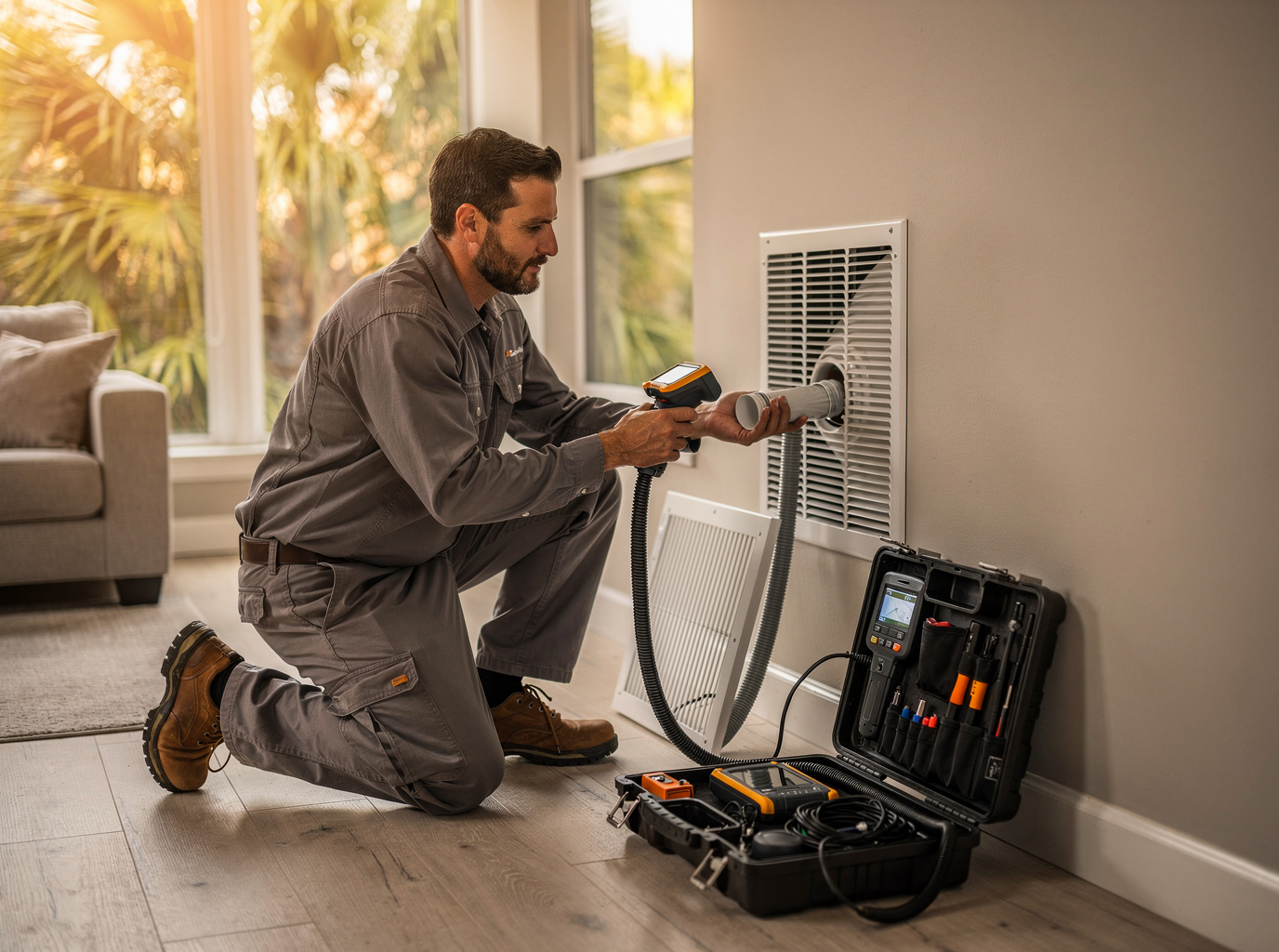
Tallahassee's humid subtropical climate keeps relative humidity high for much of the year, especially from late spring through early fall. In neighborhoods such as Midtown and College Town, many homes built before 1980 have original ductwork that leaks and pulls in attic moisture. This combination feeds mold growth inside the system and pushes allergens through supply vents. Proper IAQ work starts with measuring actual moisture levels at the air handler rather than relying on a single thermostat reading.
Killearn Estates and Southwood homes often sit on sloped lots where drainage directs rainwater toward the foundation. When crawl spaces stay damp, the return-air path can pull musty odors into the living area. Sealing and insulating ducts in these unconditioned spaces reduces the load on the cooling coil and prevents the system from running longer cycles that worsen humidity. Technicians also check for gaps around the air handler platform that allow unfiltered air from the garage or attic to bypass the filter entirely.
Downtown Tallahassee buildings near the Florida State Capitol frequently have limited mechanical space and shared walls that complicate fresh-air intake placement. Adding a dedicated dehumidifier tied to the existing air handler requires careful sizing so the unit does not short-cycle during mild winter days when temperatures rarely drop below freezing. Homeowners in these areas benefit from systems that maintain 48-52 percent indoor humidity without overcooling the space.
Technician insight
In Tallahassee the thing that catches most people out with indoor air quality is how quickly mold forms on the coil when the system short-cycles during the mild shoulder seasons. Homes in Midtown with original flex duct in the attic pull humid air across that cold coil for hours each day, and the resulting biofilm travels straight into the bedrooms.
Persistent Musty Odor in Southwood Home
A Southwood family noticed a damp smell whenever the AC ran after afternoon storms. Inspection found saturated insulation around a return duct in the crawl space pulling moisture into the system. The duct was sealed, a small dehumidifier was added to the air handler, and the odor disappeared within two days while humidity stayed under 50 percent.
Indoor Air Quality Services We Offer
✓Whole Home Dehumidification
Installs a whole-house dehumidifier integrated with the existing HVAC to hold indoor humidity between 48 and 52 percent during Tallahassee's long humid season.
✓Duct Sealing and Insulation
Locates and seals leaks in supply and return ducts located in hot attics or crawl spaces common throughout Killearn Estates and Southwood.
✓UV Germicidal Light Installation
Mounts UV lights on the cooling coil to reduce microbial growth that thrives in the moist environment created by Leon County's high summer dew points.
✓High Efficiency Filter Upgrades
Replaces standard filters with MERV-13 or higher options that capture pollen from nearby St. Marks National Wildlife Refuge without restricting airflow.
✓Air Handler Cleaning and Sanitizing
Removes built-up biofilm and debris from the evaporator coil and blower wheel in homes where the system runs continuously during peak summer heat.
Indoor Air Quality Cost in Florida
| Service | Typical Range | What Affects It |
|---|---|---|
| IAQ Assessment Visit | $125–$225 | Includes humidity mapping and visual duct inspection; price rises with multi-story homes or difficult attic access in Killearn Estates. |
| Duct Sealing Package | $450–$950 | Covers mastic sealing and insulation in attics or crawl spaces; varies by linear feet of duct and whether insulation must be added. |
| Whole-Home Dehumidifier Install | $1,400–$2,600 | Includes unit, drain line, and integration with existing air handler; higher in older Midtown homes requiring electrical upgrades. |
| UV Light System | $350–$650 | Covers coil-mounted unit and wiring; price depends on air handler size and access in Southwood or College Town properties. |
Ranges are typical for Florida and confirmed with an exact written quote before any work starts.
How it works
- 1
Initial IAQ Assessment
Technician measures humidity, temperature, and airflow at multiple points while inspecting the air handler, ducts, and filter location in the specific Tallahassee home.
- 2
Moisture and Contaminant Testing
Uses handheld meters and visual inspection to identify mold risk areas, duct leaks, and unfiltered air pathways common in Midtown and Downtown properties.
- 3
Custom Recommendation
Presents options that match the home's age, duct location, and cooling load, including dehumidification or UV solutions suited to Leon County conditions.
- 4
Installation and Verification
Completes the selected work and rechecks humidity levels and system performance to confirm the IAQ improvement holds during typical Tallahassee weather.
Pricing
Most indoor air quality projects in Tallahassee fall into mid-range pricing that scales with home size, duct accessibility, and whether a dehumidifier is added.